Deep-red Kansas votes for change as patience wears thin with Trump: ‘The economy is really taking a beating’
Özet haber: Bills have soared in rural state buffeted by tariffs and war in Iran – and Democrat Adam Hamilton’s stunning upset shows how deep economic frustrations run

Bills have soared in rural state buffeted by tariffs and war in Iran – and Democrat Adam Hamilton’s stunning upset shows how deep economic frustrations run
Linda Olson always does her homework before voting – a trait she inherited from a family invested, and interested, in politics. Her father was a photographer who took portraits of political leaders in Washington, while her grandparents were farmers who cared deeply about their industry.
In 2024, Olson’s research led her to Donald Trump. She trusted that the then-former president would improve their economic realities in Junction City, Kansas – where she was born and raised – if he returned to the White House.
But two years later, life is just more expensive. Last winter, Olson was forced to spend $700 on medication while in between insurance plans, and skipped out on doses to stretch it out longer. Her grocery bills are unrecognizably high. And fuel prices are about a dollar per gallon more expensive than last year.
“I thought at the time that he was the better choice of what we had,” Olson said of Trump in 2024. Instead, he’s been acting to “make himself richer instead of really helping the people”.
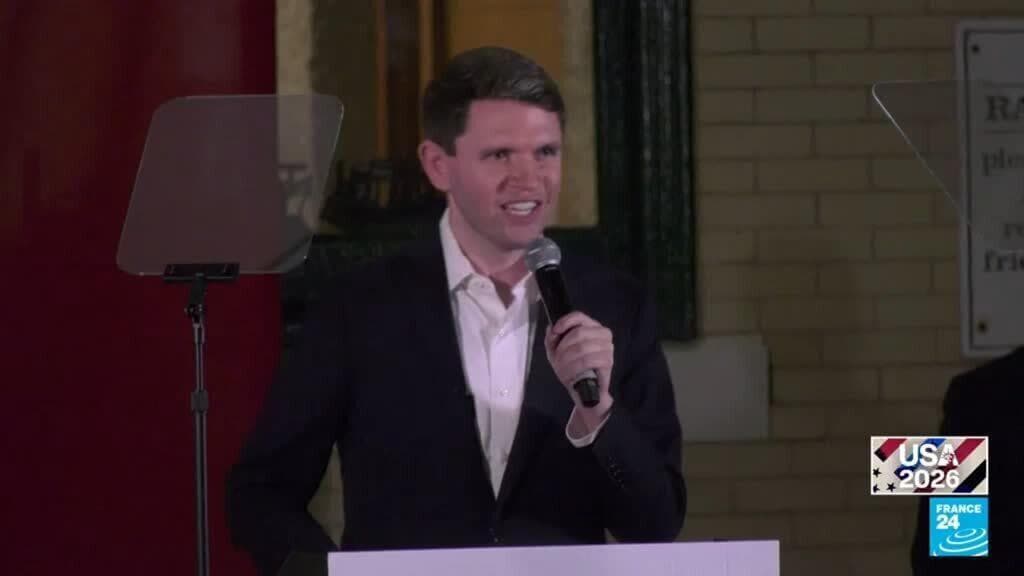
With frustrations like these looming large across the state, Kansans this week elected a Democrat, Adam Hamilton, to the US Senate for the first time in nearly a century. It was a stunning upset in what was, until recently, thought to be a reliably red stronghold.
“I’ve seen what Roger Marshall did over the eight years or so that he’s been doing this,” said Olson, of the defeated Republican senator. “And I thought, it’s time we get fresh blood up there.”
Hamilton won, in part, by flipping six counties that backed Trump in 2024 and Marshall in 2020 – a sign that, even in more remote, and traditionally conservative, areas, patience with Trump and the Republican party is wearing thin.
“Not everybody that voted for Trump is part of this cult of personality that Trump has tried to make the Republican party into,” said Michael Smith, a political science professor at Emporia State University, located in one of those six flipped counties.
“There are certainly people in Kansas that are like that: they’re pretty conservative, but they’re not beholden to Trump. And so I think one of the things this election did is peel off those people.”
Most of Kansas is made up of farmland, encompassing nearly 45m acres and employing nearly one in five Kansans. Pastures, dotted with grazing cows and their calves, hug the state’s highways. Junction City is surrounded by its famed toffee-colored prairies, so expansive that untouched grassland stretches out to the horizon on both sides of the interstate.
Kansans who ranch and farm here, in the most rural corners of the state, remain deeply Republican, according to Smith. But neighboring communities such as Junction City and Emporia, where he teaches, depend heavily on the agricultural economy and have felt the impact of the strains on farmers.